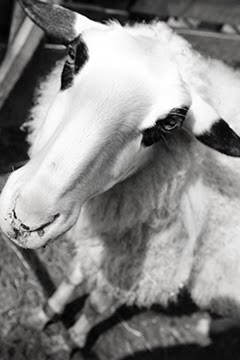
There is a new addition to the Camont family.....LAMBS. Two very precious, very new lambs.
Kate knows a couple who owns sheep, so we drove north toward their farm into the Lot region of France, where the soil and landscape is quite different from the heavy clay around Kate's place.
Kate knows a couple who owns sheep, so we drove north toward their farm into the Lot region of France, where the soil and landscape is quite different from the heavy clay around Kate's place.
On the way, we ran across two ancient Shepherd's huts built on the edges of a field.
 This one in the distance is the bigger of the two, and was probably used for a
little refuge from the sun for a shepherd as he babysat his fluffy white flock.
 The second hut was smaller and had a few inches of water still left in the bottom-
most likely once a spring.
The stonework is incredible, so precise and STILL STANDING in pristine condition. Does anyone know the artist Andy Goldsworthy? He creates structures like this one, and others with sticks, ice, stones, raindrops etc. They are temporary in that he builds them in places where they will be destroyed by natural means like melting from the sun or being carried away in the tide.
 The old farmhouse is built right on a river and at one time was a working mill. The white
building to the right is the old mill house, but is now just another barn. Walnut, chestnut
and pine trees cover the property and create a wonderful, homey nest in the valley.
 Happy sheep in their large, shady pasture.
 First task? Getting the sheep in one place to snatch up a young one.
Sounds easy right? Just put food out and they all come running.
 Craig, the owner, caught the first lamb. It is a beautiful little girl and a
local Gascon breed with black circles around its eyes.
Maybe this is mommy? Perhaps she's just a little angry?
 No one knows who will be next, and they're all on guard, watching, waiting.
 One little lamb, all alone and no one to play with.
 Kathryn has arrived! And 2 days into the Camont experience she gets her first taste
of what it feels like to hold a warm, woolly animal in her arms. When we got the lambs home, I wondered why their knees were dirty and discolored...well, here you have it.
Drink up.
 Craig demonstrates how to position the lamb. Sitting on its rear end, the little one is incapacitated and can't move from your grip. This is the position that
is generally used for shearing sheep as well.
 And of course, no farm is complete without a dog. This Australian Sheep dog, with its
brown and ginger coat, is not only a rare color but also the best dog I have ever met.
 Such a proud new mom with her new baby lamb.
Can you see the resemblance?
Thanks Craig, and good luck to Kate Hill in her new endeavor.

 We have been working hard around Camont getting things ready for the coming of spring.
 It is time for the ducks and chickens to begin sitting on their eggs, so we have to
 And it turns out, Bacon will be hatching the ducklings this year...
 Nothing is done around Camont without the "help" of the 10 chickens and Henri.
 The garden is turning around from last year's frozen, dead vines to our
 Hiding down on the Garonne Canal, Kate's boat, the
  The boat flooded a few weeks ago, and finally all the water is pumped out from
 No matter how hard we work throughout the day, we are always rewarded with
 This town is circular, with thick, stone walls surrounding and protecting it.
 Originally, when life was slightly more dangerous and you never knew who was
 The sign at the entrance reads:
 A short section of the 4-foot-thick wall is exposed along the back side of the village.
 And talk about a room with a view.
 The tiled roofs in this region were especially prominent
 Pigeons roost in the abandoned towers of Larressingle.
 Slowly but surely the duck meat was fed through the top of the grinder,
 Note the deep yellow color of the farm-fresh egg yolks-- incredible.
 Pop it in the oven, spread it on a baguette and voila! Delicieux
 Brown the meat, carrots, leeks, shallots, celery and bacon ends. In a
  Civet, served with delicious buttery polenta. Mmmmmmm
 Put the wings, carcass, neck and breast(opt) in a pot with bay leaves, peppercorn, onion, carrots, leeks, celery leaves, and fresh thyme. Add water 1/2 up the pot, boil, simmer for about 2 hours, until meet is
  This is the fun part if you like to get your hands dirty. Take all the meat off the bone, discard the meet and ligament. MASH MASH MASH the meat with your hands until it turns into a nice paste. Add: 1 c broth from pot, 1 c duck fat, 1 tsp pepper, and 1 Tbl large salt crystals.
 Now, you can put this in a terrine/wok and eat relatively soon,
 Take all the duck parts and rub with salt. Let it stand in the frig for about 24 hours.
 De-veining the liver is essential, as you do
  Press the liver down with weights to make sure there are no air pockets.
 A Perfect pot of foie gras, waiting to be eaten.
 Our very own, homemade foie gras, which we had as
 And we're off!
 Mixing a 1:2 ration of butter and flour together and keeping the hands facing
  For the pie makers out there, we know that rolling out the dough and getting it safely into the pan in one piece is never easy. Rolling it up onto the rolling pin this way helps immensely.
 Mmmm, and there is nothing better than juicy pears, fresh from the
 Participating in the cooking and note-taking are
  Someone is happy with her pie shell. And the tart was superb.
 ...but first, a little knife-handling session.
 Kate's Gascon version is much more lively and
 And who knew that making homemade crackers could be so easy? Not I. We used extra pizza dough, rolled it out, put an egg wash and some seeds on top and voila!
 Every night of great cooking deserves a candlelight dinner chez Kate.