After many long but wonderful months in France, it was time to head over to the Italian Riviera, say hello, and indulge in the wonders of Italian cuisine-- a.k.a. gnocchi con pesto(a Genovese specialty) every single day please.
The sun was shining, the air was warm and all the flowers were beginning to bloom.
We parked the car in Camogli- a small, colorful city right on the coast near Genoa. Rising up on either side of the city are vertical rock faces adorned with more small towns scattered about.
The sun was shining, the air was warm and all the flowers were beginning to bloom.
We parked the car in Camogli- a small, colorful city right on the coast near Genoa. Rising up on either side of the city are vertical rock faces adorned with more small towns scattered about.

 The little town waaayyyyy up there is called San Rocco, where we finally made it after scrambling up the mountainside from Camogli- out of breath, sweaty but happy. Time for an aperitif.
 Along the way we found numerous treasures- clothes on the line, always, cats in the
walkway and flower pots teeming with beautiful displays.
 And while some of the buildings were more run down than others,
they still retained a certain quality and charm.
 Every mountain face was covered with terraces from top to bottom, full of olive trees and gardens. Talk about learning to maximize land use- they have the process down here and not only does it work well, but it creates a beautiful landscape.
 Whether you are in France or Italy, there is a never-ending supply of vibrantly colorful houses lining the Mediterranean. The yellow building houses a restaurant at the top with a prime view.
Guests can see the Camogli port down to the right and open water all around.

 This house is in the midst of renovation using the painting technique "trompe d'oeil"
or trick of the eye, which is very popular in this region. It makes use of shadows and highlights,
creating a 3D effect on the exterior walls.
 Some very lucky person has a very nice summer home.
 Finally, we made it all the way up to San Rocco and back down to the sea.
A lovely view for a picnic, with the sun's rays and sea's breeze.
 Along the sea, fishing is obviously a huge industry. Fishermen's nets lined the walkway on the last part of our hike, ready for use when the catchin' is good.
From here we took a boat along the coast back to Camogli...enough hiking for the day, eh?
 Approaching the port, the layered look of this coastal mountain city was striking.
Camogli, meaning houses of wives, is a contraction between the Italian words for house, "casa", and wife, "mogli". When the town was full of fishermen, the wives were always left
behind at home while their husbands were out at sea.
 The life.
 Good weather draws people out of their houses like nothing else.
No more work!!--Local Camoglians crowded the main drag along
the seaside in the afternoon light.
 A finished example of trompe d'oeil fashioned in the lively colors of Camogli.
Note that the pink building on the right even went so far
as to paint on fake windows and shutters.

 Any excuse to get outside that day, even just to send a text, was crucial for catching some rays.
The cafes could finally start putting chairs outside, the gelato places were packed
with screaming children, strollers and smiling faces.
 Ciao waters of Camogli, and thank you for a glorious day in the sun.
 This one in the distance is the bigger of the two, and was probably used for a
 The second hut was smaller and had a few inches of water still left in the bottom-
 The old farmhouse is built right on a river and at one time was a working mill. The white
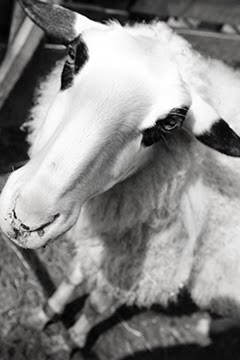
 Happy sheep in their large, shady pasture.
 First task? Getting the sheep in one place to snatch up a young one.
 Craig, the owner, caught the first lamb. It is a beautiful little girl and a
 No one knows who will be next, and they're all on guard, watching, waiting.
 One little lamb, all alone and no one to play with.
 Kathryn has arrived! And 2 days into the Camont experience she gets her first taste
 Craig demonstrates how to position the lamb. Sitting on its rear end, the little one is incapacitated and can't move from your grip. This is the position that
 And of course, no farm is complete without a dog. This Australian Sheep dog, with its
 Such a proud new mom with her new baby lamb.
 We have been working hard around Camont getting things ready for the coming of spring.
 It is time for the ducks and chickens to begin sitting on their eggs, so we have to
 And it turns out, Bacon will be hatching the ducklings this year...
 Nothing is done around Camont without the "help" of the 10 chickens and Henri.
 The garden is turning around from last year's frozen, dead vines to our
 Hiding down on the Garonne Canal, Kate's boat, the
  The boat flooded a few weeks ago, and finally all the water is pumped out from
 No matter how hard we work throughout the day, we are always rewarded with
 This town is circular, with thick, stone walls surrounding and protecting it.
 Originally, when life was slightly more dangerous and you never knew who was
 The sign at the entrance reads:
 A short section of the 4-foot-thick wall is exposed along the back side of the village.
 And talk about a room with a view.
 The tiled roofs in this region were especially prominent
 Pigeons roost in the abandoned towers of Larressingle.
 Slowly but surely the duck meat was fed through the top of the grinder,
 Note the deep yellow color of the farm-fresh egg yolks-- incredible.
 Pop it in the oven, spread it on a baguette and voila! Delicieux
 Brown the meat, carrots, leeks, shallots, celery and bacon ends. In a
  Civet, served with delicious buttery polenta. Mmmmmmm
 Put the wings, carcass, neck and breast(opt) in a pot with bay leaves, peppercorn, onion, carrots, leeks, celery leaves, and fresh thyme. Add water 1/2 up the pot, boil, simmer for about 2 hours, until meet is
  This is the fun part if you like to get your hands dirty. Take all the meat off the bone, discard the meet and ligament. MASH MASH MASH the meat with your hands until it turns into a nice paste. Add: 1 c broth from pot, 1 c duck fat, 1 tsp pepper, and 1 Tbl large salt crystals.
 Now, you can put this in a terrine/wok and eat relatively soon,
 Take all the duck parts and rub with salt. Let it stand in the frig for about 24 hours.
 De-veining the liver is essential, as you do
  Press the liver down with weights to make sure there are no air pockets.
 A Perfect pot of foie gras, waiting to be eaten.
 Our very own, homemade foie gras, which we had as